Tuesday, April 2, 2013

Portugal: 1 car, 2 adventurers... 7 versions of bacalhau.

1 car. Second rental car in Europe! This still doesn't compare with my 4 rental cars over the period of 2 months this summer, but it was particularly special since the one they gave me looked like a spaceship and had only 10 km on it! Maybe they figured it was safest with me since the under 25 year olds have to pay extra insurance fees...

2 adventurers.

 
 Who would've guessed it?

3 languages.  Portuguese, Spanish, or English? Although I could read it rather easily, I knew nothing but "Obrigada" (thank you) and "Olá" (hello) in Portuguese, so that was out. Then I was left with the Spanish or English dilemma. On the one hand, if I spoke in Spanish, they understood me. On the other hand, if they noticed that Spanish wasn't my first language, I would be left looking like an ignorant fool who thinks that Portuguese and Spanish are the same language. This was complicated even further by the fact that we ran into so many Spanish tourists who did speak Spanish. So, every conversation was a slow start, switching languages until we found something in common. My favorite part of the whole experience, however, was when people assumed you didn't speak their langugae. A girl from the U.S.A. had a whole conversation with her boyfriend about my very European pink pants. What she didn't realize was that the person inside the European pants was also from the states and was giggling at the fact that she was talking about me so obviously from just a few feet away. Then the Spaniards did the same thing, commenting on Napala's and my morning run alongside the water. Spaniards don't run too much to begin with and the fact that we were two girls, doing so in a torrential downpour, quickly brought us to their attention. "Que listas son..." (How smart they are...). I know they were being sarcastic BUT we got to all of the monuments faster and burned off more custard sweets because we didn't bother with the illusion that an umbrella would be any help. ¡Toma!

This is actually much nicer weather than what we ran in earlier that day.  

4 different accommodations. We hit up 3 different Airbnbs and a hostel. They were all quite the experience. Lisboa: adorable modern apartment. Coimbra: hostel converted from a nun's orphanage/hospital? Aveiro: "guesthouse" where the woman had made a living renting out the extra rooms in her townhouse... and she decorated everything in a very "artsy" way. It had charm? Porto: an entire house (we thought we rented a room...) right next to the airport for easy access to our 6:30 AM flight!

5 major cities.
Napala's Portuguese friends told us that we couldn't just go to one place in Portugal. So they mapped out a route for a 4 day, 5 city trip with a few pit stops to nearby towns along the way. Here's a snapshot of each:

Main square in Lisboa (the capital)

Flag from the bridge in Coimbra (Portugal's Salamanca)

 A man fishing in one of the canal's in Aveiro (Portugal's Venice)

 Pena National Palace... a castle in a cloud in Sintra

 
View from the other side of the river in Porto  

6 calendar days. We left Wednesday night and got back in time for Napala to go to work on Monday morning. Thankfully, I had Monday to get myself semi-organized before heading back to school. March was a crazy month for traveling! It definitely made me appreciate the sense of home I feel in my humble abode in Madrid.

7 versions of bacalhau. For those of you that don't know, Portugal is known for their salted cod. One of my cooperating teachers told me, Napala's Portuguese friends told her, our cheese man told us... we got the idea. They say there are enough ways of cooking it that you can eat it 365 days a year, a different way each day. Well, we didn't eat 365 versions, but we did manage to squeeze in 7 over the 4 day adventure.

One of the favorites. A simple but wonderful (both to the taste buds and the eyes) version of the infamous fish.

Alright, enough of the numbers. Let me hit a few other highlights...

Apparently the Portuguese are in love with sweets. This is quite contrary to the Spaniards way of eating but we certainly didn't complain. We ate a number of neighborhood/city specific treats which made the adventure all the more sweet. (No pun or rhyme intended.)

In Belém, a neighborhood just outside of downtown Lisboa, there is a bakery that makes the Pasteles de Belém just as they did 200 years ago. We topped these delicious custard treats with cinnamon and powdered sugar and thoroughly enjoyed. It didn't hurt that we were staying only a few blocks away from the magic.

 Pasteles de Belém

In Sintra, they make a cinnamon cheesecake tart that energized us on our hike up the mountain to the National Pena Palace.

 Queijadas

We hit a few others but I think I'll save your keyboard from getting ruined by your drool and move on.

Portugal is also covered with ceramic tiles. Walking down the street, I enjoyed looking at (and, yes, taking pictures of) the tiles of each individual house.


It was difficult to spend too much time wandering around the streets though, because most of our days in Portugal looked like this:

Foggy and rainy.

Okay, that was at the top of the mountain in Sintra... but still. Napala and I realized quickly that our colored pants showed the rain more, but dried faster. I realized that I should've packed the rain boots instead of the bathing suit. And we both valued each other's ability to laugh at our ridiculously wet-cat-like appearances and enjoy the experiences despite the puddles that were no longer only on the sidewalks, but inside our shoes.

After all, the rain kept us from leaving any restaurant too soon. Which was quite desirable since we hit up some very unique but beyond delicious holes in the walls.

First there was the one-woman show wine bar in an old aqueduct in Lisboa. We literally had to ring a doorbell to get in, but our Airbnb hosts recommended it so we rang with great expectations. The 3 hour process of delicious morsels and Portuguese wine flights was one of the most enjoyable meals I've ever had in my life.

Bacon wrapped figs in an orange sauce.

Our hosts also recommended a tiny restaurant which was converted (well as much as was necessary to fit tables inside) from an old bait and tackle fishing shop. Their entire menu consists of different cans of fish (you pick the flavor; they open the can, drain the oil, and put it on a plate with a few sprigs of parsley) and a few simple but tasty appetizers made from canned fish varieties.

Decoration and dinner in one!

Last but not least, we stumbled upon OBAIRRO, an adorable restaurant in Aveiro. This place put a modern, artsy twist on all of the traditional Portuguese foods. From a plate of Portuguese cheeses to a seafood foam (really, foam describes this concoction better than soup) to bacalhau to the ovo molino dessert, we were beyond pleased.

 Their place mats had cartoons and descriptions of typical people from the neighborhood: the abuela, the fish man, etc.

Last but not least, we saw quite a few cool sites. 

We went to Cabo de Roca, the most Western point of continental Europe. I waved to all of my friends on the East coast, but I think you must've been busy because nobody waved back.

These are the pink pants that girl wanted :)

We saw The Monastery of the Hieronymites in Belém (neighborhood in Lisboa)...

I mostly like it because it reminds me of Downton Abbey.

In Lisboa we took the famous cable car down the hill. This 3 euro, 3 minute ride was a little anti-climactic. Needless to say, we should've taken it UP the hill instead.

¡Patatas! More Spanish tourists...

When we were in Coimbra, we saw the University, which is the oldest university in Portugal and one of the oldest in the world. We visited the academic jail, the chapel, and, my favorite, the library. It made me feel like I was Belle in the castle library. Not too shabby.

University of Coimbra

In Aveiro we took a ride in a gondola through the city's canal. Our tour guide was hilareous, but only spoke in Portuguese. The English tour they offered was actually the guy driving the boat who would summarize 5 minute long speeches into 2 sentences. Then he kept describing a particular kind of gondola as the kind that brings the hog in from the sea to put it in the fields. It wasn't until halfway through the trip when I acted out a pig that we realized it was not in fact hogs being brought in, but algae. Oh, language barriers.

Gondola in Aviero canal

Right outside Aveiro is a small town called Costa Nova, which is on the beach. The main draw is the multitude of picturesque, striped beach houses.

 Houses in Costa Nova

But if you only looked at the houses, you would miss out on the intriguing amount of foam that is on the beach.

This is sea foam... but where's the green of the color "sea foam green"?

The waves come in as pure foam, which can be so distracting that you might not realize that the next wave is much larger than the rest and might possibly take you back into the ocean with it. Okay, that might not happen to you but it happened to me!

 Sooooooooo wet.

Last but not least, Napala and I took a tour of Taylor's Port Wine Bodega. When in Porto, right?

Barrels of Tawny

Well my friends, Portugal was certainly an adventure! But it also brings my month of travel to an end. Zaragoza, Bilbao, Poland, and half the country of Portugal... It was wonderful, but I think I'll spend April within 10 miles of my house :)

Much love from slightly East of the most Western point of Occidental Europe,
Amber

Tuesday, March 19, 2013

The beauty of Poland

You may be wondering, "Why Poland?"
My best response is, "Why not?"

I tried to come into both of my European adventures without fixed expectations. I didn't want to make a bucket list of places to visit or things to do for fear of getting too wrapped up in the checklist instead of the experiences. And, I didn't want to risk disappointment if I didn't get everything "done."

So, I stepped wholeheartedly into the low-cost airline culture which basically consists of going wherever you can get cheap flights. One of my teachers chuckled when I told her I was going Poland, telling me, "You know, you used to choose where you wanted to go and then search for tickets."

Granted, Napala's and my decisions on Bilbao and Portugal were based more on cheap flights than Liz's decision to go to Poland. Liz invited me to come to Poland with her in November; she was making intentional plans because she wanted to go to Auschwitz. I  figured since tickets were cheap and my friend Erica gave it raving reviews, why not? Thus, the decision to head to Krakow was made.

Liz and I flew into Krakow on Friday morning to find... SNOW. We're talking piles along the roads, packed snow on the sidewalks, and wet sneakers. I hear you... "Amber, you should've known not to wear sneakers to Poland in March." Yes, you are right, but my UGGs weren't exactly an option. When in Madrid, I decided against my two nice pairs of leather boots and figured with some warm socks, my canvas Vans would be the most comfortable for four days of walking.

Canvas. Snow. Very wet. Little feeling in my toes.
By the end of the first day, I bought boots.

That tidbit of information aside, let me tell you about our adventures...

Day 1

After checking into our hostel, Liz, Wagner (a Brazilian who is studying in Bilbao and was staying at our hostel), and I headed out to get some lunch with the plan of later meeting up with a free walking tour. We missed the free walking tour, but we were exposed to our first Polish meal and realized that we would be enjoying the low prices Krakow's restaurants had to offer. In a nice restaurant in the main square, my soda and pancakes stuffed with chicken, cheese, broccoli, and cauliflower topped with a creamy garlic sauce (mmmmm... sorry, no picture this time!) brought me to the grand total of 25 polish zloty, or $7.87. Not too shabby.

Warm and satisfied, we headed down to another part of town to see Schindler's factory. This is the factory of Oskar Schindler, the German who saved over 1,200 Jews by employing them (and often their family members).


A church we passed on our way to Schindler's factory. I told you there was snow!


We could've used a few more of these arrows pointing us in the right direction. We got a little lost in the back neighborhoods trying to find Schindler's factory.
 
Outside the factory 

It was neat to see the factory that the movie Schindler's List was based on and the detailed museum inside gave us a good understanding of Krakow's invasion during WW2. The unfortunate effect of museums (especially detailed, historical ones), however, is that they often tire you out. Also, since we woke up at 4:00 AM to get a taxi to the airport, we were a little sleep deprived. So, we made the decision to head back to the hostel in the early evening.

Conveniently, our hostel is located across the street from a mall. So we took a detour and I began the search for boots. Unfortunately, the Polish people seem to think that it is spring and didn't have many cold-weather shoe options in stores. This, combined with the fact that I typically have no need for cold-weather shoes, made the shopping a little more difficult. In the end, however, I happily found a pair of good rain boots, which will serve me in the spring rain that the madrileños keep warning me about.

We wandered around the mall a bit more and chuckled about the trouble a few of the Polish names (listed on luggage tags) would present in Spain. For example...

Hola.
Hola.
¿Cómo te llamas?
Ola.
Hola... ¿hablas espanol?
Sí...
Pero, ¿cómo te llamas?
¡Ola!

Day 2

On the second day, we were determined to catch the free walking tour around the Old Town. And success was ours...

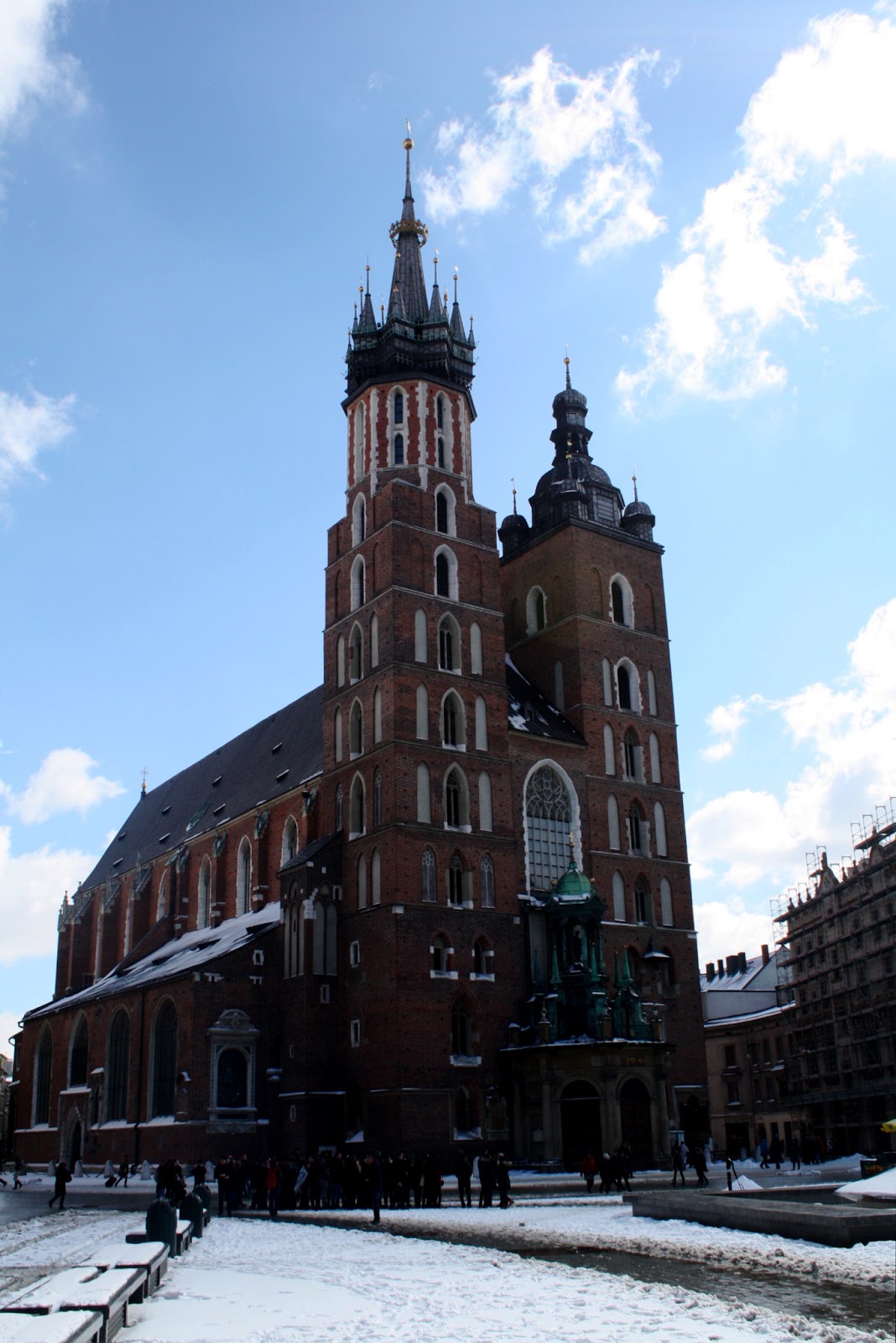
First, we saw St. Mary's Basilica. This church is located in the Main Markets Square in the Old Town. A very interesting characteristic about it is that, "On every hour, a trumpet signal—called the Hejnał mariacki—is played from the top of the taller of St. Mary's two towers. The plaintive tune breaks off in mid-stream, to commemorate the famous 13th century trumpeter, who was shot in the throat while sounding the alarm before the Mongol attack on the city. The noon-time hejnał is heard across Poland and abroad broadcast live by the Polish national Radio 1 Station" (Wikipedia... an extremely academic source).

Mr. Tour Guide (he told us we could feel free to call him that), however, told us that apparently that is a legend that was spread by Eric P. Kelly when he wrote the book, The Trumpeter of Krakow. Apparently the tour guide he had had when he was in Krakow made the story up because she didn't know why it was like that; then it spread like wild fire.

St. Mary's Basilica

Also in the Main Market Square we saw a statue of  Adam Mickiewicz, a Polish Romantic poet. The monument was destroyed during the Nazi occupation of Krakow, when all traces of Polish culture were removed and the square itself was renamed Adolf Hitler Platz. However, most of the figures were recovered from the scrap yard and it was returned to the Main Market Square after WW2 ended.

The Main Market Square itself is an UNESCO site because of how much of the medieval town remains. Krakow was one of the only cities in Poland not completely destroyed during WW2; about 90% of the country (and all major cities besides Krakow) was destroyed as a result of the war.

 Adam Mickiewicz in the Main Market Square

Last but not least, we saw the Cloth Hall in the Main Market Square. Inside are trading stalls that were built during Medieval times. They used to sell cloth, leather, wax, and salt, but now they sell mostly touristy trinkets.

Cloth Hall

As interested as Liz and I were in the walking tour, the countless stories from Mr. Tour Guide were getting a little long winded and we didn't think we could bear (or rather, our toes could bear) another hour of the 2.5 hour tour. So we snuck off, had a coffee in a little bar, warmed up considerably, and then continued on with our explorations.

On our own we found... 

A beautiful Polish pottery shop

Pierogis galore

 A Jewish cemetery in the Jewish quarter

It was fun to wander with no fixed plans. We also saw the Old Synagogue, went into the High Synagogue, and enjoyed a view of the Wawel castle by sunset.

The book shop in the High Synagogue

 
The sunset was beautiful, but it also served as a warning that it was about to get really cold!

To finish off a wonderful day, Liz and I headed to the traditional Polish style restaurant suggested to us by our friendly hostel worker. There I ate the most wonderful borsch soup ever and...

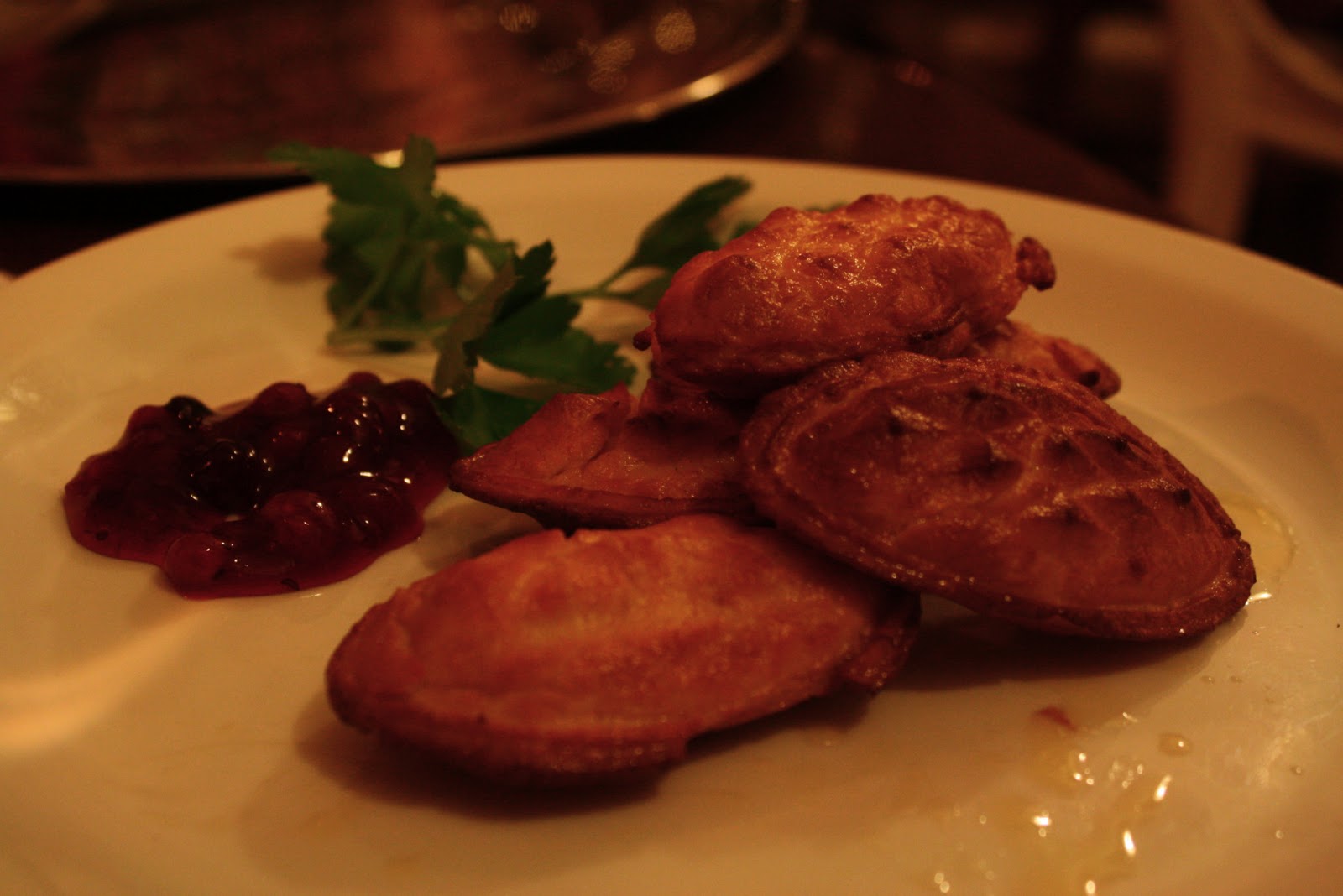
Ewe cheese with cranberries

You may find yourself thinking, "What's ewe cheese like?" You might guess it's similar to goat cheese, as I did. That would've been delicious. Instead, I found myself chewing a squeaky (literally... you could hear the squeaks), white rubber that had neither an interesting flavor nor a desirable texture. Well, you can't win them all.

Day 3

On our third day, we set out to do what we came here to do. We headed off to Auschwitz.

All throughout the tour, I wondered how I would explain the experience. I think it's honestly something you have to experience yourself because anyway I describe it won't do it justice. I seriously considered not posting anything, but our tour guide said something that stuck with me, "I don't consider you tourists. I consider you visitors. This is not a tourist attraction. This is an educational center... Many of us who work here have lost someone here and we do this so that there will never be an Auschwitz again." He also emphasized the fact that it was the prisoners of the camp that wanted it to be preserved. The countless artifacts, buildings, and words are a memorial to the largest cemetery that exists without any tombstones.

Thus, I will try my best to share a few of the most influential memories of my experiences in Auschwitz. But I know starting this endeavor that I will fall short of explaining it how it deserves to be explained.

First we went to Auschwitz I, the original camp of the complex. It was first used for German criminal prisoners and Polish intellectuals but was quickly deemed to be too small, hence the other 47 camps. It's location was chosen because it was previously used as Polish army artillery barracks and could thus be converted easily into a concentration camp.

I hadn't realized that concentration camps were originally invented by the British, and were synonymous with isolation camps. The Germans, however, converted the concentration camps into "extermination camps."


The gate above the entrance to Auschwitz I.
"Labor makes you free."

Otto Friedrich wrote in The Kingdom of Auschwitz about why the German commander, Rudolf Höss, chose to use this saying: " He seems not to have intended it as a mockery, nor even to have intended it literally, as a false promise that those who worked to exhaustion would eventually be released, but rather as a kind of mystical declaration that self-sacrifice in the form of endless labour does in itself bring a kind of spiritual freedom."

Another surprising realization for me was how much seemed to be known about the situation in Auschwitz by other countries at the time. I had assumed that if people had really known, they would've stopped it. However, it was quite the contrary. Countless companies and countries did business with Auschwitz.

The National French Railway (SNCF) transported countless Jews to Auschwitz

Just a few of the ways companies collaborated with Auschwitz:
  • Bayer used prisoners to test their medications
  • IBM sold counting machines to the Nazis to make them more efficient in counting their prisoners
  • German textile companies bought human hair to make warm socks for German soldiers
  • Alliance insurance insured Auschwitz in case of natural disaster, etc.
It's unbelievable to realize how effective group think can become in allowing pure evil to exist in the world. So many people knew what was happening to their fellow human beings, yet they didn't gather together to stop it.


An entire hallway was filled with shoes of prisoners. Yet this is an insignificant amount in comparison with the total.

Not surprisingly, many committed suicide by running into these electric fences.

Next, we traveled 3 km to Auschwitz II-Birkenau. This extermination camp was built with the bricks of the nearby Polish houses that Nazi Germans had their prisoners destroy. Auschwitz II-Birkenau was much larger than Auschwitz I and was designed with a railroad that led directly to the gas chambers. A few young, strong prisoners were selected to live and work, but the majority were sent to the gas chamber, where 2,000 people could be murdered in 20 minutes time.

 
The end of the railroad tracks in Auschwitz II-Birkenau

One of the craziest facts I learned was that some people bought their own tickets to the concentration camp. Promised with a better life and an opportunity to start a new future, they paid to board a cattle car which shortly took them to their death.

The cattle car came filled with humans and left with any belongings or body parts that could be reused by the Germans.

And while I'm thinking about the opportunities in my future, I realize that those who survived were likely about my age. While I am blessed to be starting a job, traveling around Europe, and receiving flowers for my birthday, life is not like that for many. Both in the past and the present, there are many whose lives were taken from them before they even began.
 
Our fellow human beings deserved more than this.

Throughout the day, we saw many Jewish groups with Israeli flags and kippahs. The melodies they sang brought an eery peace over the space.

Raising the flag above the ruins.

Plaque

"Those who cannot remember the past are condemned to repeat it."
- George Santayana

This was my humble attempt at remembering.

Day 4 

Our last day in Krakow was quite relaxing. We woke up late, chatted with our hostel friends over breakfast, and headed out to see Wawel castle, a gothic castle built in the 14th century.

When we got there, however, we remembered that most museums in Europe are closed on Mondays. This was no exception. Oops. So we just wandered around the cathedral and the outside of the castle.


Outside the cathedral

View from Wawel castle

The castle

Having seen the last major attraction, Liz and I headed over to the Jewish quarter for a cup of hot chocolate (not quite as good as Paris but delicious all the same). We went to a quaint cafe that had a real fire in the fireplace and chairs set around tables with old Singer sewing machines built in.


We went in just for you, Mom!

Last, but not least, we had to eat. So we decided to check out a "bar mleczny," or in English, a milk bar. These Polish cafeterias serve traditional foods and many milk-based foods. They were common when Poland was a communist state and meat was rationed, since the food is inexpensive and often vegitarian. The milk bars allowed workers who did not have cafeterias at their work place to still have access to quality food at low prices.

Liz and I wanted to go to a "local" milk bar (though I'm not sure there even are touristy milk bars), so we asked our hostel worker for a suggestion. She gave us a suggestion for one near the hostel, but then added, "But I would go to one here... I would go to one in this area..." (pointing to an area right off from the Jewish quarter).

Intrigued, I thought, "Why wouldn't I want to go to that one?" She told me that it's not very nice inside and that it's "really Polish." Sounds perfect.

We asked the worker at the cafe and she also suggested one right off from the Jewish quarter. So off we went. I was tempted to take pictures to document it, but it seemed a little invasive so I avoided it.

I would describe the milk bar as a cafeteria-style restaurant that looked like a mix of a retirement home and a soup kitchen. Most of the people eating there came alone and it lacked the normal chatter of a restaurant. Also, I doubt anyone there spoke English... we looked extremely out of place amongst the locals. So to make ordering easier, I copied two menu items off of the board onto a slip of paper and showed it to the woman at the cash register. I was a bit unsure of what I was getting.

But, for the price of 6,30 polish zlatey, I got a huge bowl of some delicious cauliflower soup and about 10 pierogi ruskie. These are pierogis filled with mashed potatoes, white cheese, and onion. They didn't measure up to the pierogis from the other day, but for less than 2 euros, I have no complaints.

In the streets of Krakow

-----------------------------------------------------------------------

On our first day here, I asked Liz if she thought Krakow was a beautiful city. When she said no, I quickly agreed with her, glad I wasn't the only one underwhelmed by the appearance of the city. But I shouldn't have judged the city's worth based on how pretty the buildings are. The people and history of Krakow, Poland, are beautiful in their own way and I am blessed to have been able to experience all of it.